Christopher’s arrest for assaulting a police officer
The Curious Incident of the Dog in the Night-TimeChristopher’s arrest for assaulting a police officer turns a moment of sensory and communicative overload into a formal encounter with the law. Christopher hits an officer who has lifted him by the arm; the officer arrests him, and the eventual caution records the blow as accidental and unintended. The episode’s significance lies in the collision between a procedure meant to establish what happened and Christopher’s difficulty managing rapid questions, physical contact, and the assumptions built into police authority.
The encounter and its escalation
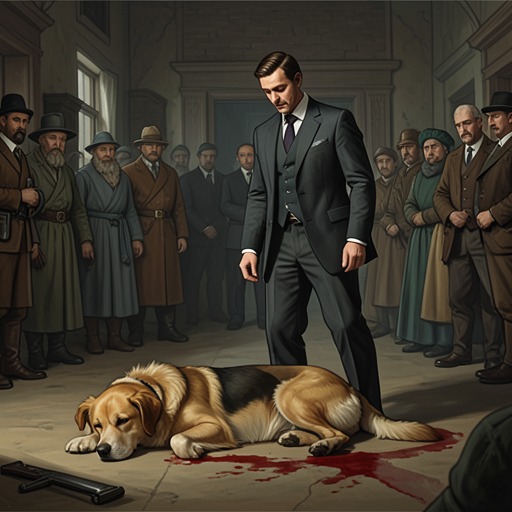
When the police arrive after Wellington’s killing, Christopher observes them through exact particulars: the policewoman has a hole in her tights at her left ankle, with a red scratch in its middle, while an orange leaf is caught under the policeman’s shoe. The policewoman leads Mrs. Shears back toward the house. Christopher’s attention to these details sits alongside a broader trust in police as people whose uniforms and numbers make their role legible.
The questioning, however, becomes difficult to bear. Christopher explains that questions arrive too quickly and pile up in his mind like loaves at the bakery where Uncle Terry operates slicing machines. When a slicer cannot keep pace, bread accumulates and blocks the process; the image gives a concrete form to Christopher’s sense of mental overload. The officer’s repeated questioning does not slow to match his capacity to respond.
Christopher rolls onto the lawn, presses his forehead to the ground, and makes the groaning sound Father recognizes. He describes it as a response to too much information from the outside world, comparable to turning up a radio tuned between stations until static drowns out everything else. When the policeman takes hold of his arm and lifts him to his feet, Christopher dislikes the touch and hits him. The narrative links the assault directly to this physical intervention without suggesting that Christopher set out to injure the officer.
Arrest and caution
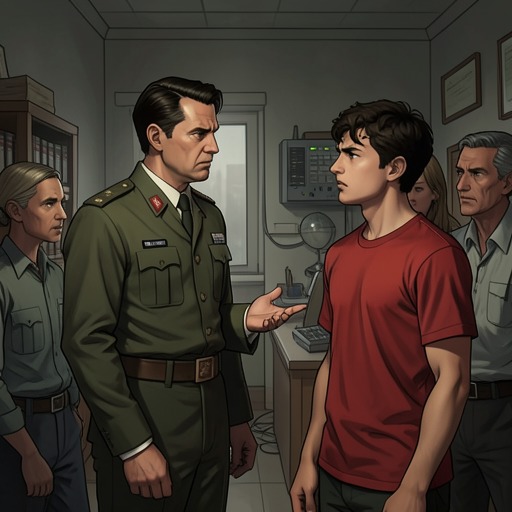
The policeman looks at Christopher before stating, “I am arresting you for assaulting a police officer.” The announcement calms Christopher because it is familiar from television and films: the institution’s scripted language makes the situation recognizable even as the arrest itself follows from an action he did not intend as an attack. The contrast is central to the episode. Christopher can understand the formula as a known rule, while the circumstances that led to it have been shaped by an interaction he could not comfortably process.
At the station, the officer asks whether Christopher is telling the truth. Christopher answers that he always does. The policeman decides to give him a caution. Christopher initially understands the word through a tangible comparison, asking whether it is a certificate he can keep. The officer explains that it is instead a record stating that Christopher hit a policeman, but that it was an accident and he did not mean to hurt him. Thus the caution distinguishes the physical fact of the blow from its intent, while also making that distinction part of an official record.
The officer warns that further trouble could lead the police to consult the record and treat Christopher more seriously. Christopher says he understands. The account does not describe a trial or further penalty: the policeman lets him go, and they return to the front desk. Christopher collects the belongings that had been placed in a plastic bag—his Swiss Army knife, string, a wooden puzzle piece, three pellets of rat food for Toby, £1.47, a paper clip, and his front-door key—before going home in Father’s car. Their ordinary specificity makes release concrete: the police encounter ends with his possessions restored and a ride home, but the caution leaves a record of the incident behind.
A later encounter on the journey
The episode’s meaning recurs when Christopher travels toward London to live with Mother. A policeman suggests they walk to a cashpoint, and Christopher tells him not to touch him. When Christopher says he intends to live with Mother, the officer replies that his father may object. Christopher thinks the policeman is going to take him back to Father; because policemen are supposed to be good, that possibility frightens him rather than reassuring him. He runs, the policeman grabs him, and Christopher screams. The officer then lets go and proposes returning to the station so that Christopher, the policeman, and Father can discuss where Christopher will go.
The two encounters reveal a consequential difference between the official role Christopher trusts and the bodily experience of being handled by an officer. In the first, a rapid interrogation and a lift by the arm culminate in a blow, followed by arrest and a caution that explicitly recognizes accident and lack of intent. In the later scene, Christopher’s fear is shaped by the prospect of being returned to Father, and the policeman’s grab prompts flight and screaming. The recurrence does not make the encounters identical: the first is a police response at the scene of an assault, while the later one arises from Christopher’s attempt to reach Mother. Together they show how uniforms and formal procedures can be intelligible to him while questioning, touch, and uncertainty about where he will be taken remain difficult and frightening.
Narrative role
Because Christopher recounts the arrest himself, the reader encounters the event through his close attention to visible detail and his attempts to explain what happens inside his mind. The bakery blockage and radio static are not abstract labels imposed from outside; they are his own ways of making an overwhelming experience communicable. The account also separates observation from interpretation: it records the officer’s action, Christopher’s response, the legal wording, and the explanation of the caution, allowing the procedural outcome to be understood without treating the blow as deliberate violence.
The arrest therefore marks both a breach and a limit in Christopher’s trust of authority. Police are initially predictable because they wear uniforms and have identifiable duties; the arrest itself becomes calming once it takes the familiar form of a television phrase. Yet the physical contact that precedes it, and the later fear of being taken back to Father, complicate that confidence. The caution preserves the distinction between what Christopher did and what he meant, while the repeated police encounters show that being able to recognize a rule does not ensure that an interaction governed by it will feel safe.